
Ghee in Ayurveda and Hindu Ritual
From the kitchen to the sacred fire, how ghrita earns its place in Ayurveda and worship.

Kushal K
06 Nov 2026 • 6min
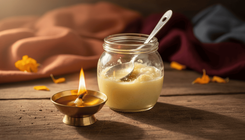
Ghee in Ayurveda is much more than a cooking fat. The Sanskrit word is ghrita, and the tradition treats it as food, as medicine and as an offering. Here are the places ghee appears, in the order a household would meet them: the kitchen, the vaidya's dispensary, the lamp, the sacred fire and the abhishekam tray.



Ghee as everyday food and medicine
Ayurvedic texts class ghee as a sneha, an unctuous or oily substance. Its taste is described as sweet and its nature as cooling. It is traditionally said to pacify vata and pitta, two of the three doshas. People of a kapha constitution are usually advised to take less. Classical texts such as the Charaka Samhita and the Sushruta Samhita both discuss ghrita at length.
Ghee is also said to support agni, the digestive fire, without aggravating it. A spoonful on warm rice or dal is the familiar household form of this idea. Old ghee, called purana ghrita, is described as a distinct preparation for particular conditions, not a casual kitchen item. These are traditional claims, so anyone with a health condition should ask a qualified vaidya before using ghee medicinally.
Ghee as a carrier of herbs
Ayurveda also uses ghee as a base. Medicated ghees are made by slowly cooking ghee with herbal paste and decoction. The tradition holds that ghee carries the herbs' qualities deep into the body. Triphala ghrita and Brahmi ghrita are two well-known examples, the first associated with the eyes and the second with the mind and memory.
In panchakarma, the classical cleansing programme, ghee has another role. In a stage called snehapana, the patient drinks ghee in measured, gradually increasing amounts to prepare the body. This is always done under supervision. Medicated ghee is not something to improvise at home from a recipe, because the herbs, the proportions and the cooking time all matter.
Ghee in the lamp
The most common ritual use is the humble diya. A cotton wick in a small lamp of ghee is lit at the home shrine, usually at dawn or dusk, and many families regard it as the most auspicious light to offer. The lamp is not decoration. It is an offering of light, and the ghee is chosen because it is a pure, clean substance.
Other oils have their place too. Sesame oil is widely used in lamps, especially in the south, and some temples and traditions prescribe a particular oil for a particular worship. If ghee is not available, a plain oil lamp is not considered a lesser offering.
Ghee in the sacred fire
In a homa or havan, ghee is the central offering. It is poured into the fire with a ladle called a sruva as each mantra ends with the word svaha. In the Vedic understanding, Agni is the one who carries offerings to the devas, and ghee is what keeps the flame bright and steady. Grains, herbs and wood sticks called samidha are added alongside it.
The quantity offered at each ahuti (single offering) is small. What matters in the tradition is the mantra, the attention and the fire being tended properly. Ghee for the fire should be pure, as adulterated ghee burns poorly and defeats the purpose.
Ghee in abhishekam and panchamrita
In many temples and homes, ghee is one of the five substances of panchamrita: milk, curd, honey, sugar and ghee. These are poured over the deity during abhishekam, the ritual bath, and the mixture is later distributed as prasad. The order in which the substances are poured differs between traditions.
Ghee also appears in panchagavya, the five products of the cow used in certain purification rites. Beyond that, ghee is the natural base of prasad: laddu, halwa and many other sweets offered as naivedya are cooked in it.
How ghee is made at home
There are two common routes. The traditional bilona method sets milk into curd, churns the curd with a wooden churner to separate butter, and then cooks that butter. The simpler route collects cream from boiled milk over several days, churns it into butter and proceeds in the same way.
From the butter onward, the method is the same. Heat it gently on a low flame, stirring now and then. It will foam and crackle as the water cooks off. Then the foam settles, the milk solids at the bottom turn a pale golden brown, and a nutty fragrance rises. Switch off the flame at that point, because burnt solids make the ghee bitter. Let it cool a little, then strain through clean muslin into a dry glass jar. Always use a dry spoon, since water spoils ghee.
Why the tradition names cow ghee
The phrase cow ghee tradition points back to the place of the cow in Hindu life. Milk, curd and ghee from the cow are all treated as sacred, and the cow's products form the panchagavya. Classical Ayurvedic texts describe ghee from different animals and rank cow ghee as the best.
In practice, households differ. Some use only cow ghee for puja and homa, and some temples specify it. Others use whatever pure ghee they have, including buffalo ghee. Most teachers agree that purity matters more than winning an argument about origin. What you offer should be clean, honestly made and given with care.
Common questions
Does homemade ghee need to be kept in the fridge?
Pure ghee does not need refrigeration if it is kept in a clean, dry, airtight jar away from sunlight and moisture. Most spoilage comes from a wet spoon or water droplets. If it smells sharp or sour, or shows mould, discard it and do not offer it in puja.
Can everyone eat ghee every day according to Ayurveda?
Ayurveda does not treat ghee as a fixed daily dose for everyone. A small amount is common in many traditional households, but the right quantity depends on digestion, season, age and constitution. Someone with high cholesterol, fatty liver or a weak appetite should ask a vaidya first.
Can I use oil instead of ghee for my puja lamp?
Yes. If ghee is not available, a plain sesame or other oil lamp is accepted in most traditions, and what matters is the sincerity of the offering. Some families keep a ghee lamp for special days and use oil on ordinary days.

Related Articles


