
Onam Festival Traditions: The Story of King Mahabali, Pookalam and the Sadya
How Kerala celebrates the harvest with a demon king's blessing, flowers and a feast

Abhilash Ramakrishna
06 Nov 2026 • 6min
Onam is Kerala's harvest festival, celebrated across communities with a rejoicing that feels both ancient and immediate. The onam festival traditions are rooted in the story of a generous demon king, transformed each year through flowers, dance, games and one of the world's largest vegetarian feasts. For those celebrating, Onam is ten days of colour and abundance; for those encountering it for the first time, it opens a window into how harvest festivals can be about something deeper than gratitude for grain.
The heart of every onam celebration is the return of King Mahabali. This is where the festival truly lives.



The Story of King Mahabali
Mahabali was an asura, a demon king, but not a villain in the way that word might suggest. He ruled over three worlds with such fairness and generosity that his subjects forgot what suffering was. There were no lies, no theft, no unkindness. His kingdom was one where the poor and the rich stood equal. The gods, watching from heaven, grew uneasy. Their rituals were being neglected, their sacrifices forgotten. Why would anyone invoke the gods when a demon king had made life perfect?
Vishnu intervened. He took the form of Vamana, a Brahmin boy, and asked Mahabali for a gift: three paces of land. Mahabali, known for his generosity, agreed without hesitation. Vamana then grew to cosmic size, covering the earth with one step and the sky with another. When he asked where to place the third, Mahabali offered his own head. By this act he was sent to the netherworld, but Vishnu granted him a boon: he could return to visit his people once each year to see that they were happy and thriving.
That annual visit is Onam.
How Kerala Celebrates: Pookalam and the Home
The first act of celebration is the pookalam, a circular arrangement of flowers laid on the ground, built fresh each morning and added to through the ten days of the festival. There is no fixed design or rigid rule. A pookalam might be as simple as yellow marigolds arranged in concentric circles, or as elaborate as dozens of flowers layered in patterns that take hours to create. Red, yellow, white and pink flowers bloom across Kerala's homes, arranged with care because they are a welcome mat for the arriving king.
The pookalam sits in the courtyard or on a mat, often at the centre of the home's activity. Children gather around it. Women who have made these arrangements for decades say there is a rhythm to it, a meditation in selecting each flower and placing it exactly where it belongs. The flower market becomes crowded in the days before Onam; vendors call out varieties by name, and people choose blooms as though assembling a greeting.
Around the pookalam, the household gathers for games. Kaikottikali is a clapping game with a rhythmic chant, played in circles. Thumbi Tullal involves jumping and singing games. Kalari Payattu, the ancient martial art of Kerala, is performed and watched. There are boat races on the backwaters, and music ensembles called Thiruvathira Kali where women dance in circles singing songs of Krishna and of harvest. The television shows relay races and Onam-themed dramas.
The Sadya: The Heart of the Feast
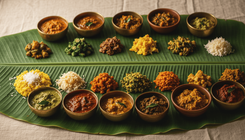
At the centre of Onam is the sadya, possibly the world's most elaborate vegetarian meal. It is served on a banana leaf, and the experience of eating one is almost ceremonial: a single serving contains between 20 and 30 dishes, though the exact number varies by family and region.
The sadya begins with rice, placed first on the leaf. Around it are arranged curries, pickles, condiments and chutneys: avial (a dry curry of vegetables and coconut), olan (pumpkin and beans in a pale coconut gravy), erissery (a thick lentil and vegetable dish), sambar (a complex vegetable broth), rasam (a thin, tangy soup), and payasam (a sweet, often made with jaggery, coconut and rice). There are fried items: pappadum, fries, fritters. There are pickles made from mango, lime and other fruits. The leaf is crowded; every inch of it holds something.
A sadya is not a casual meal. It takes days to prepare. Vegetables are chopped, spices are ground, coconut is scraped fresh. Families gather in kitchens to make these dishes together, and the sadya becomes a repository of family recipes—some kept exactly as grandmothers made them, some adjusted by each generation. When you eat a sadya, you are eating the distilled knowledge and care of the household that made it.
The meal is offered first in recognition of the harvest and of the abundance that Mahabali's visit represents. It is shared with guests, extended family, sometimes the community. Leftovers are rare because the portions are generous and the hunger is real.
What Onam Means Beyond the Festival Days
The ten days of Onam are called Thiruvonam, with different names for each day. The most auspicious is Thiruvonam itself, the tenth day, when Mahabali is believed to be most present. But the festival is understood as something that touches the entire year—the promise that generosity returns, that a community can hold abundance in common, that the bonds between people matter more than wealth or status.
The onam festival traditions are tied to Kerala's landscape and seasons. The monsoon has passed, the crops are ready, the land is green. In earlier times, this was when grain stores were full and communities could feast and celebrate without worry. The festival has survived through centuries because it names something true: that gratitude, generosity and togetherness are reasons enough to gather.
For those outside Kerala, learning about Onam reveals how deeply a harvest festival can be woven with mythology, ritual and food. It shows a tradition where a demon king is honoured not despite his nature but because he represents what a wise ruler should be. It reminds us that festivals are not ornaments to be admired from a distance, but living practices that remake themselves each year.
Common questions
When is Onam celebrated each year?
Onam is celebrated in August or September and lasts ten days, culminating on Thiruvonam, which falls on different dates each year following the Malayalam calendar. The exact date shifts annually because the Malayalam calendar is lunar-based.
Can people outside Kerala celebrate Onam?
Yes, Onam is increasingly celebrated by Keralite communities living across India and globally. While the most traditional celebrations happen in Kerala with boat races, Kaikottikali dances and large family gatherings, the core practices of arranging a pookalam and preparing a sadya can be observed anywhere.
How many dishes are typically in an Onam sadya?
A traditional sadya usually has between 20 and 30 dishes, though the exact number varies by family and region. Each household follows its own recipe collection, and what appears on one family's leaf may differ from another's, making every sadya unique to the home that prepares it.

Related Articles


