
Pradakshina: Why Hindus Circle Deities and Temples
The sacred act of circling a deity or temple in worship

Sunil Chaurasia
06 Nov 2026 • 6min
What is Pradakshina
Pradakshina is the act of circling a deity, a sacred object, or a temple in the clockwise direction. The word comes from Sanskrit: "pra" means forward, and "dakshina" refers to the right side. When you walk around something while keeping it on your right side, you are moving pradakshina. This practice is one of the oldest expressions of respect in Hindu worship, done by millions of devotees every day in temples, homes and sacred sites across India and beyond.
The right side holds significance in Hindu tradition. To keep something on your right—in this case, the deity or temple—expresses humility and reverence. You are not walking past the sacred; you are acknowledging its centrality by moving around it. Pradakshina is silent worship. Unlike a mantra or prayer spoken aloud, it is action that speaks.



How Pradakshina Works
When you perform pradakshina, you walk in a circle around the object of worship, keeping it to your right as you move. In a temple, this typically means walking around the sanctum sanctorum, or garbha griha, where the main deity resides. At home, you might circle around a small idol, a yantra, or even a sacred plant. The pace is unhurried and meditative. Some people walk slowly and deliberately; others move at a normal walking speed. The rhythm is yours.
The practice creates a connection between the worshipper and the sacred. As your feet trace the circle, your mind turns toward what lies at the center. There is no fixed number of circles a person must complete, though certain numbers hold meaning in Hindu practice: three circles is common, as is seven, nine, or even one complete circuit. Some traditions observe particular practices around pradakshina: women might not circle during menstruation in some temples, though this varies by region and community.
Many devotees touch the ground or bow in the direction of the deity at specific points during the pradakshina—often at the cardinal directions or at particular shrine points. Some people chant a mantra, the name of the deity, or "Om" as they circle. Others remain silent. These variations emerge from family practice, regional custom, and personal devotion. All express the same intention: the honoring of the sacred through movement.
Why Pradakshina Matters
Pradakshina is not merely an action performed before or after worship. It embodies a truth central to Hindu philosophy: that the divine is not distant from the devotee but present and real, and worthy of honor shown through the body and movement. When you circumambulate a temple or deity, you are declaring that this place or form holds the sacred.
The circle itself carries meaning. It has no beginning and no end, just as the divine has no beginning and no end. By moving in a circle, the devotee participates in that infinity. The clockwise direction moves with the apparent path of the sun across the sky—the direction of auspiciousness in Hindu tradition. This is why aksara (circumambulation), as pradakshina is sometimes called, always moves to the right, never to the left.
In temples, pradakshina forms part of the prescribed worship sequence. You may offer flowers, ring a bell, or make an offering to the deity, and then circle the sanctum. This movement is understood as taking the blessings—the prasad or grace—of the deity into yourself. You leave with what you took in: the presence of the sacred.
Pradakshina in Different Contexts
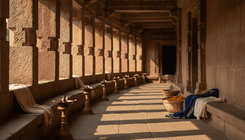
In a major temple, the architecture often accommodates pradakshina. Covered passages, or pradakshina paths, may encircle the main shrine, allowing devotees to complete their circles in an orderly flow. Some temples have multiple concentric pradakshina paths, allowing devotees to circle at different levels of the temple. The largest temples might have pradakshina paths around additional shrines within the same complex.
At home, pradakshina requires no special setting. A small altar, a corner where a deity's image is placed, or even a sacred plant can be the center of your circle. Some families perform pradakshina around a tulsi plant each evening, combining it with prayer or the lighting of an oil lamp.
Pradakshina also occurs during festivals and at sacred sites. Pilgrims circumambulate the main shrine at temples during important observances. At sites like Varanasi or Rishikesh, devotees circle temples, ghats, or sacred trees as part of their spiritual journey. In some traditions, pradakshina of a guru—walking around a teacher as a mark of respect—is practiced, though this is less common in contemporary practice.
The number of pradakshinas performed sometimes relates to intention. Some devotees complete a specific number as an offering or a vow. Others circle once in the morning as part of daily practice. There is no rule binding all Hindus: the practice flows from devotion and the customs of one's family and community.
The Experience of Pradakshina
Pradakshina is a meditation in motion. Unlike sitting meditation, which stills the body, pradakshina moves it with purpose. The repetitive motion, the focus on keeping the sacred object to your right, and the inward turning of attention create a state of absorbed concentration. Time seems to slow. The bustle of the temple or the outside world falls away.
For many, pradakshina is how they feel close to the divine. It is tactile and bodily in a way that words sometimes are not. The devotee is not thinking about the deity from a distance; they are moving around it, spiraling inward and outward at once. This direct engagement through movement is part of why pradakshina has remained central to Hindu worship for thousands of years, unchanging and unquestioned.
Pradakshina expresses a simple truth: the sacred is real, worthy of honor, and present here and now. Each step around the deity or temple is an acknowledgment of that presence.
Common questions
How many times should I do pradakshina around a temple?
There is no fixed rule. Common numbers are one, three, seven or nine circles, depending on personal choice or family tradition. Some devotees complete just one pradakshina as part of their morning worship, while others may circle many times as an offering or vow.
Can I do pradakshina at home without a temple?
Yes. You can perform pradakshina around any sacred object: an idol, a yantra, a photograph of a deity, or even a tulsi plant. The practice is the same—walk clockwise around it, keeping it to your right, with focus and respect.
Is there a specific mantra or chant I should use during pradakshina?
No set requirement. Some devotees chant the deity's name, recite Om, or repeat a chosen mantra. Others circle in silence, letting the movement itself be the prayer. What matters is your intention and attention, not a particular spoken form.

Related Articles


