
Saraswati is the Hindu goddess of knowledge, music, flowing water, abundance and wealth, art, speech, wisdom, and learning.
The earliest known mention of Saraswati as a goddess is in the Rigveda.[6] She has remained significant as a goddess from the Vedic period through the modern period.
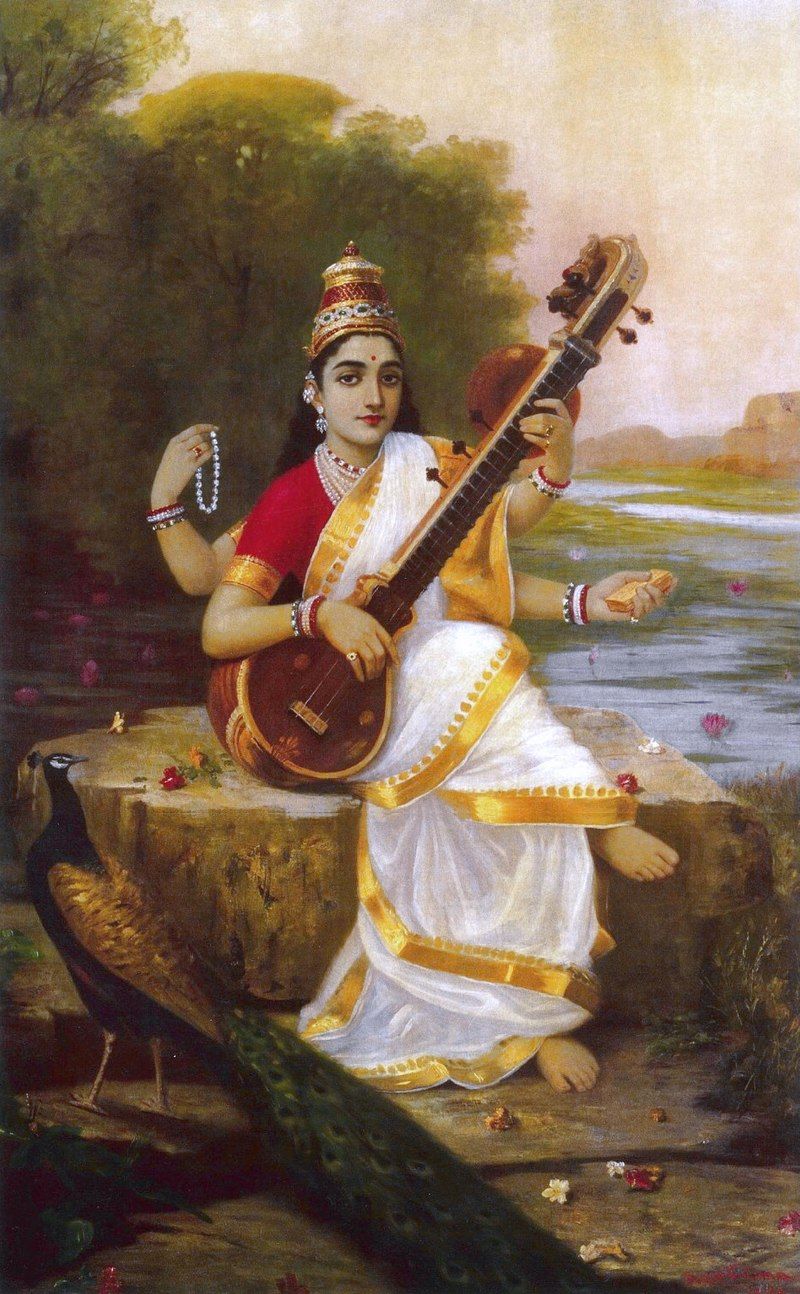
Saraswati
24 Sep 2024 • 4min
Goddess Saraswathi
Saraswati (Sanskrit: सरस्वती, IAST: Sarasvatī), also spelled as Sarasvati, is the Hindu goddess of knowledge, music, flowing water, abundance and wealth, art, speech, wisdom, and learning.[1] She is one of the Tridevi, along with the goddesses Lakshmi and Parvati.[2][3][4] She is a pan-Indian deity, also revered in Jainism and Buddhism.[5][4]
The earliest known mention of Saraswati as a goddess is in the Rigveda.[6] She has remained significant as a goddess from the Vedic period through the modern period.[7] She is generally depicted with four arms (which hold four symbols: a book, a rosary, a water pot, and a musical instrument called the veena). The festival of Vasant Panchami (the fifth day of spring, and also known as Saraswati Puja and Saraswati Jayanti in many regions of India) is celebrated in her honour.[8] Traditionally, the day is marked by helping young children learn how to write the letters of the alphabet.
Saraswati is a Sanskrit fusion word of saras (सरस्) meaning "pooling water", but also sometimes translated as "speech"; and vati (वती), meaning "she who possesses". Originally associated with the river or rivers known as Saraswati, this combination, therefore, means "she who has ponds, lakes, and pooling water" or occasionally "she who possesses speech". It is also a Sanskrit composite word of sarasu-ati (सरसु+अति) which means "one with plenty of water".[12][13]
The word Saraswati appears both as a reference to a river and as a significant deity in the Rigveda. In initial passages, the word refers to the Sarasvati River and is mentioned as one among several northwestern Indian rivers such as the Drishadvati. Saraswati, then, connotes a river deity. In Book 2, the Rigveda describes Saraswati as the best of mothers, of rivers, of goddesses.[13]
Her importance grows in the later Vedas composed after the Rigveda as well as in the later Brahmana texts, and the word evolves in its meaning from "waters that purify", to "that which purifies", to "vach (speech) that purifies", to "knowledge that purifies", and ultimately into a spiritual concept of a goddess that embodies knowledge, arts, music, melody, muse, language, rhetoric, eloquence, creative work and anything whose flow purifies the essence and self of a person.[13][14]
Names and epithets
Saraswati (Sanskrit: Sarasvatī) is known by many names. Some examples of synonyms for Saraswati include Brahmani (power of Brahma), Brahmi (goddess of sciences),[15] Bharadi (goddess of history), Vani and Vachi (both referring to the flow of music/song, melodious speech, eloquent speaking respectively), Varnesvari (goddess of letters), Kavijihvagravasini (one who dwells on the tongue of poets).[16][1]
Other names include: Ambika, Bharati, Chandrika, Devi, Gomati, Hamsasana, Saudamini, Shvetambara, Subhadra, Vaishnavi, Vasudha, Vidya, Vidyarupa, and Vindhyavasini.[17]
In the Tiruvalluva Maalai, a collection of fifty-five Tamil verses praising the Kural literature and its author Valluvar, she is referred to as Nāmagal and is believed to have composed the second verse.[18][19]
Outside Nepal and India, she is known in Burmese as Thurathadi (သူရဿတီ, pronounced [θùja̰ðədì] or [θùɹa̰ðədì]) or Tipitaka Medaw (တိပိဋကမယ်တော်, pronounced [tḭpḭtəka̰ mɛ̀dɔ̀]), in Chinese as Biàncáitiān (辯才天), in Japanese as Benzaiten (弁才天/弁財天) and in Thai as Suratsawadi (สุรัสวดี) or Saratsawadi (สรัสวดี).[20]

Related Articles


