
Shukla Paksha and Krishna Paksha: The Two Halves of the Lunar Month
Moon's bright half, moon's dark half.
Dharmayana
01 Oct 2026 • 5min
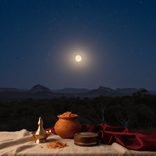
Shukla paksha and Krishna paksha are the two halves of the lunar month in Hindu tradition. Shukla paksha is the waxing fortnight—the fifteen days when the moon appears to grow brighter, from the new moon to the full moon. Krishna paksha is the waning fortnight—the fifteen days when the moon appears to darken, from the full moon back to the new moon again. Together they make one lunar cycle of about 29.5 days, and they form the backbone of the Hindu calendar.
The names are straightforward: shukla means "bright" or "white", and krishna means "dark" or "black". In Sanskrit, paksha means "fortnight" or "half-month". So shukla paksha is literally the bright half, and krishna paksha is the dark half. These are not poetic names but descriptions of what you see in the night sky.



How the lunar month is divided
The lunar month begins on a new moon night, called Amavasya. The moment the crescent first becomes visible, shukla paksha begins. From that point, the moon waxes (grows brighter and rounder) for roughly fifteen days until the full moon, called Purnima. At Purnima, shukla paksha ends. Krishna paksha then begins and lasts another fifteen days as the moon wanes back toward darkness and the next Amavasya, where the cycle begins again.
The exact length of each paksha varies slightly from month to month because the moon's orbit is not perfectly regular. Some lunar fortnights are fourteen days, others sixteen. But fifteen days is the standard measure, and it is the one used in temple calendars and ritual planning.
Why this matters for practice and ritual
The panchanga (the Hindu calendar) organises all dates and rituals around these lunar fortnights. Most major festivals fall on specific days within one paksha or the other—Holi on the full moon of Shukla Paksha Chaitra, for example, or Diwali on the new moon of Krishna Paksha Kartik. Many pujas and vrats (religious observances and fasts) are also prescribed for particular tithis (lunar days) within a particular paksha.
Individual tithis (the thirteen lunar days in each paksha) are believed in traditional practice to carry their own qualities. A tithi in shukla paksha is generally considered auspicious for activities that require growth—beginning new projects, starting a course of study, initiating a business. Krishna paksha tithis are thought more suitable for completion, inward work, and practices that benefit from the darker, calmer energy.
This is not seen as superstition in the tradition, but as an observation of rhythms in nature. The moon visibly affects the tides and the water in our own bodies. Vedic astronomy tracks these phases with precision, and practitioners have long aligned their activities with them. Whether you follow this belief or not, understanding the pakshas is essential to reading a panchanga and knowing when festivals actually fall.
Regional and calendrical variations
Most of India follows the same lunar calendar, so shukla paksha and krishna paksha mean the same thing everywhere. However, different regions name the months differently and may begin the year at different times. Some regions in South India follow the panchanga slightly differently, or celebrate festivals on different dates, but the paksha system itself is universal across Hindu tradition.
The one variation worth knowing is that some calendrical systems name the pakshas differently. The waxing moon is sometimes called Shukla Paksha or Gaura (the fair half), and the waning moon Krishna Paksha or Krishna (the dark half). You may also see "bright fortnight" and "dark fortnight" in English sources. These all refer to the same thing.
How to read the paksha in a panchanga
Every entry in a panchanga shows the paksha alongside the tithi. When you look at a lunar date, you will see something like "Kartik Krishna Amavasya" or "Chaitra Shukla Purnima". The word between the month and the tithi tells you which paksha it falls in. If you are planning a ritual or checking when a festival occurs, you need both pieces of information: the month, the paksha, and the specific tithi.
If you use a panchanga app or website, it will usually show you the current paksha and tithi. Many also display a moon phase icon so you can see at a glance whether the moon is waxing or waning. Learning to read these simple markers takes only a few minutes and makes the calendar far less mysterious.
The deeper significance
In the wider spiritual tradition, the lunar fortnights are seen as reflecting states of mind and natural cycles. Shukla paksha, with its growing brightness, is associated with clarity, expansion, and manifestation. Many new practices are begun during this time. Krishna paksha, darker and contracting, is associated with introspection, release, and turning inward. It is a good time for practices like pranayama (breath work) or meditation that deepen inward awareness.
This is not a rule to follow rigidly. But it is one reason why the distinction matters beyond mere calendar-keeping. When you know which paksha you are in, you can attune your own rhythms to the moon's rhythms—and through that, to the natural cycles of growth and rest that govern all life.
Common questions
How many days are in shukla paksha and krishna paksha
Each paksha is typically fifteen days, though the exact length varies between fourteen and sixteen days from month to month because the moon's orbit is irregular. Together they make one lunar month of approximately 29.5 days.
Can I start something new during krishna paksha
While krishna paksha is traditionally associated with inward work and completion rather than new beginnings, there is no absolute prohibition. Many people begin practices during this time. The distinction is a guide, not a rule.
What is the difference between tithi and paksha
A tithi is a single lunar day (there are thirty in a lunar month), while a paksha is a fortnight or half-month made of roughly fifteen tithis. So a paksha contains multiple tithis, and each tithi falls within one paksha or the other.

Related Articles


