The Nature of Consciousness: A Hindu-Neuroscience Mashup
Consciousness Unveiled: Bridging Hindu Wisdom and Neuroscience for a Deeper Understanding of the Mind

Meghana C
23 Sep 2024 • 5min
The Essence of Consciousness: Hindu and Scientific Perspectives
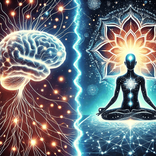
Imagine you're at a party. In one corner, you've got a group of Hindu Advaitins discussing the nature of reality. In the other, a bunch of neuroscientists are arguing over brain scans. Now, could these two groups actually be talking about the same thing?
Welcome to the wild world of consciousness studies, where East meets West in a cosmic dance of neurons and Nirvana.
Let's start with our Hindu friends. They're all about this thing called "Chit" or pure consciousness. But we're not talking about your garden-variety "I think, therefore I am" consciousness. No, this is consciousness with a capital C – the fabric of reality itself. It's like they took the red pill, saw through the Matrix, and decided the code itself was conscious.
Now, the Advaita Vedanta school takes this to eleven. They're saying your individual consciousness (Atman) is actually identical to the universal consciousness (Brahman). It's like finding out you're not just a character in the video game, but the entire gaming console. It is a mind bending concept.
Meanwhile, over in the neuroscience corner, they're taking a slightly different approach. They're all about that brain, 'bout that brain, no trouble. To them, consciousness is what happens when you get enough neurons to throw a party. It's an emergent property, like how a bunch of ants suddenly become a colony, or how my socks suddenly become sentient after a week under the bed.
But here's where it gets interesting. Some modern theories are starting to sound suspiciously... well, Hindu. Take the Integrated Information Theory. It's suggesting consciousness might be a fundamental property of certain physical systems. It's not quite "consciousness is everything," but it's a lot closer to the Hindu view than "consciousness is what happens when meat thinks too hard."



Exploring States and Properties of Consciousness
Hinduism recognizes different states of consciousness beyond the typical waking state. The Mandukya Upanishad, a key text in Hindu philosophy, elaborates on four states of consciousness:
- Jagrat (waking state): The state of normal waking consciousness, where we perceive the external world through our senses.
- Svapna (dream state): The state of dreaming sleep, where the mind creates its own reality.
- Sushupti (deep sleep state): A state of dreamless sleep, characterized by the absence of mental activity.
- Turiya: Described as the fourth state of consciousness, Turiya transcends the other three states. It is considered the state of pure consciousness, beyond sensory perception and mental activity.
The concept of Turiya hints at levels of awareness that modern science is only beginning to explore. And guess what? Science is starting to catch up. Researchers are poking around altered states of consciousness, looking at what happens in the brains of meditators, and generally trying to map out this weird terrain that Hindu Advaitins have been exploring for millennia.
Synthesis: Subjective Experience and Objective Measurement
The Hindu emphasis on subjective experience as a valid means of investigating consciousness offers a complementary approach to the objective methods of neuroscience. Contemplative practices like meditation, deeply rooted in Hindu traditions, are now being studied scientifically for their effects on brain function and conscious experience.
Research into mindfulness and other meditative practices has revealed their potential to alter brain structure and function. Studies have shown changes in areas associated with attention, emotion regulation, and self-awareness in long-term meditators. This convergence of ancient wisdom and modern scientific inquiry is opening new frontiers in our understanding of consciousness.
Practical Implications: Consciousness and Emotional Well-being
But why should you care about all this cosmic consciousness talk? Well, it turns out that understanding consciousness – whether through ancient wisdom or modern science – might actually help you live a better life. Regular meditation and contemplation on the nature of consciousness can lead to better emotional regulation, increased empathy, and improved resilience. It's like upgrading your mental operating system.
- Detachment from transient emotions: The realisation that our true nature (Atman) is identical to universal consciousness (Brahman) can help create a sense of detachment from transient emotional states, reducing their impact on our overall well-being.
- Increased self-awareness: Regular meditation practice enhances self-awareness, allowing individuals to observe their thoughts and emotions without being overwhelmed by them.
- Stress reduction: The practice of reaching higher states of consciousness through meditation has been scientifically proven to reduce stress and anxiety.
- Improved emotional regulation: Understanding consciousness as a fundamental aspect of reality rather than just a product of brain activity can lead to a more balanced perspective on life's challenges, improving emotional regulation.
- Enhanced empathy and compassion: The concept of interconnectedness in Hindu philosophy can foster greater empathy and compassion, as one begins to see others as extensions of the same universal consciousness.
- Increased resilience: Regular meditation and contemplation on the nature of consciousness can build mental resilience, helping individuals bounce back from emotional setbacks more quickly.
So, next time you're feeling stressed, anxious, or overwhelmed, remember: you might just be the universe experiencing itself. And if that doesn't help, there's always ice cream 😁
References
For those of you who want to dive deeper into this rabbit hole, here are some suggestions for further reading:
- "The Upanishads" translated by Eknath Easwaran – For a accessible introduction to Hindu philosophy.
- "Consciousness: A Very Short Introduction" by Susan Blackmore – A quick overview of scientific theories of consciousness.
- "The Character of Consciousness" by David Chalmers – For those who want to grapple with the hard problem of consciousness.
- "Altered Traits" by Daniel Goleman and Richard Davidson – On the science of meditation and its effects on the brain.
Remember, consciousness is a vast and complex topic. These resources are just the tip of the iceberg – or should I say, the tip of the Atman?

Related Articles
Try a fuller and better experience on the
Dharmayana App