
Tulsi Plant Worship: Why Tulsi Is Worshipped in Hindu Homes
A pot of holy basil at the centre of the home is a goddess, a guest and a household remedy.

Kushal K
06 Nov 2026 • 6min
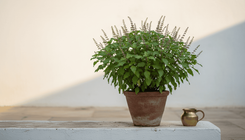
Tulsi plant worship is a daily practice in many Hindu homes. The tulsi, or holy basil, is treated as a living form of the goddess Lakshmi and as a plant especially dear to Vishnu. Families water it each morning, circle it, and keep it in a place of honour in the courtyard or on the balcony. The reasons sit in a mix of Puranic story, household custom and long use of the plant as medicine.



The core idea: a plant that is also a goddess
In Hindu thought the divine is not kept apart from the natural world. A river can be a mother, a mountain a deity, a tree a dwelling place of the sacred. Tulsi is the clearest example in the home. It is not worshipped as a symbol of something far away. It is greeted as a presence that has come to live with the family.
Tulsi is addressed as Tulasi Devi, and in many households she is called by a respectful family name. The plant grows in an ordinary pot, yet people bow to it, offer water to it and speak to it. That small daily act turns the house into a place where worship happens even when no formal puja is under way.
Vrinda and the story behind the plant
The tradition links tulsi with Vrinda, a devoted wife in a Puranic story whose steadfastness was tied up with a demon king, Jalandhara. In the usual telling, Vishnu was drawn into the events that ended her husband's life, and Vrinda's grief and devotion were so great that she became the tulsi plant. Vishnu then accepted her as a beloved presence in his worship.
The details change from text to text and from region to region. Some versions are harsher on Vishnu, some on Jalandhara, and some stress Vrinda's own power. What stays constant is the outcome: tulsi is Vishnu's cherished companion, which is why her leaves are placed on his offerings and on those of his forms, such as Krishna and Shaligram.
This is also the root of Tulsi Vivah, the ritual marriage of the tulsi plant to Vishnu, observed in the Kartika season around Prabodhini Ekadashi. The timing varies with the lunar calendar and with local custom, so check a panchanga for the year.
How belief shows up in daily care
The home setting makes the idea concrete. Many families keep tulsi on a raised platform called a tulsi chaura or Vrindavan, sometimes carved with niches. Where there is no courtyard, a pot on a sunny balcony or windowsill serves the same purpose.
The tulsi watering ritual is the heart of the practice. Usually the first act of the day, after a bath, is to offer a little water to the plant, often with a short prayer or a bow. Some people circle it. Some light a lamp near it at dusk. Customs vary by family, and none of them needs elaborate equipment.
Two things are common across households:
- The plant is approached clean, ideally after bathing, and not with footwear.
- The water is offered gently, as one would offer it to a guest, not poured out carelessly.
This is why tulsi puja can be as short as a minute or as full as a lamp-lit evening prayer. The attitude matters more than the length.
Rules of respect around the plant
Many families follow customs about plucking leaves. The common ones are not to pluck after sunset, not to pluck with the nails if it can be avoided, and to ask permission before taking a leaf. Some households do not pluck on Ekadashi or on Sundays. These rules differ between families and sampradayas, so treat them as habits of care, not universal law.
The reasoning is practical as well as devotional. A plant picked at night or torn roughly is harmed. A plant that is touched only when needed lasts longer and grows fuller. The customs teach restraint toward a living thing.
The leaves are also not simply thrown away. When a plant dries out, many people let it return to the soil or a flowing river with a prayer, in the same spirit in which worn-out sacred objects are treated.
Tulsi in Ayurveda and everyday health
Tulsi is Ocimum tenuiflorum, and Ayurveda has used it for a very long time. It is commonly taken as a tea or decoction with ginger and honey for coughs, colds and sore throats. Many households still keep a few leaves for exactly this purpose, so the plant is useful and sacred at once.
It would be wrong to say worship exists only because of medicine, or that medicine is only an excuse for worship. In the tradition the two sit together. A plant that heals is a plant that deserves gratitude, and gratitude is what the daily offering expresses. For any health condition, a qualified vaidya or doctor is a better guide than a household remedy.
What worshipping a plant really means
A frequent question is whether tulsi plant worship is superstition, or a form of nature worship that confuses the object with the divine. The tradition answers differently. The plant is not seen as a magical object that grants wishes on contact. It is a reminder, kept at the centre of the house, that the sacred is present in what grows, feeds and heals.
There is a further layer. Tulsi is sometimes described as a household's spiritual anchor: wherever she is tended, the home is understood to be tended too. Families who keep the plant speak of it as marking the rhythm of the day. Water in the morning, a lamp in the evening, a leaf with the offering. The belief is held in the hands before it is held in the mind.
That is also why a tulsi in a modest pot counts as much as one on an ornate chaura. What the tradition asks for is steady attention and respect for the plant, not display.
Common questions
Can I keep a tulsi plant indoors or on a balcony?
Yes. Many families keep tulsi on a sunny balcony or windowsill, since it needs several hours of direct light. A common household recommendation, drawn from vastu custom, is an east or north-east spot, but the plant does best wherever it gets steady sun and regular water.
What should I do if my tulsi plant dries up?
Do not discard it with household waste. Many families bury the dried plant in soil or release it in flowing water with a short prayer, then replant a fresh sapling. Some also save the seeds, which are often the easiest way to start a new plant.
Can tulsi leaves be offered to every deity?
Tulsi is most closely tied to Vishnu and his forms. Customs differ for other deities: many traditions avoid offering tulsi to Ganesha, and practice for Shiva varies by region and family. If you are unsure, follow your own family or temple tradition.

Related Articles


