
What is a puja thali and what goes on it
Sacred vessel, gathered offerings, prepared heart

Dharmayana
01 Oct 2026 • 7min
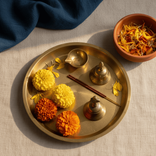
A puja thali is the shallow metal vessel in which you gather everything you need to worship. It sits at the centre of your prayer space, holding the flowers, incense, water, and other items you'll use during your puja. In some traditions it is called an aarti thali, especially when the focus is on the lamp used to honor the deity. The thali itself—usually made of brass, copper or stainless steel—is not merely practical. It is the container that says: this moment, this space, this gathering of simple things, is sacred.
The thali serves a purpose that goes beyond convenience. When you arrange your worship items in one vessel, you create a boundary between the ordinary and the devotional. You are saying to yourself and to the divine: I have set this apart. I am ready. This is why many people keep their puja thali in a specific place, bringing it out for daily worship or for rituals. Some families have thalis that have been used for decades, darkened by ash and incense, marked by years of practice.



The core items in a puja thali
Most puja thalis contain a similar set of offerings, though what you include depends on your family practice and the deity you worship.
A small oil lamp, or diya, sits at the heart of many thalis. This lamp—often a small brass cup filled with oil and a cotton wick—is lit to welcome the divine presence. The light is central to aarti, the act of circling the flame before a deity as an offering of gratitude and devotion.
Fresh flowers come next. Marigolds are common because they are sturdy and bright; roses and jasmine appear in many homes too. Some people offer only a few petals, others gather whole blooms. The flowers can be placed loose in the thali or woven into a small garland.
Water is essential. You will need it to rinse your hands before worship, to sprinkle as a purifying gesture, and often to offer to the deity. Some thalis have a small cup or spoon for this purpose. Many people also keep a small piece of coconut in their thali—the white flesh can be offered, and the hard shell is sometimes broken as part of ritual practice.
Incense sticks, or agarbatti, fit naturally into a thali. As they burn they fill the space with fragrance and smoke, which many consider an offering in itself. Some people prefer dhoop, a solid incense cake that releases a heavier, earthier smoke.
Ash from incense, or vibhuti, often collects in the thali and is kept there for use in worship—applied to the forehead or offered to the deity. Sandalwood paste, or chandan, serves the same purpose and is sometimes kept in a small container within the thali.
A small bell, or ghanta, may sit in the thali. Rung at specific moments in the puja, it marks transitions and is said to invite attention and create sacred space through sound.
Many people keep a small idol or image of their chosen deity inside or near the thali, though some prefer to keep the thali as a vessel of offerings rather than a display. This is a matter of personal and family practice.
Choosing and caring for your thali
A puja thali can be as simple or as elaborate as your practice calls for. Many people use an everyday stainless steel plate or shallow bowl; others own a brass thali passed down through generations, each dent and discoloration a record of worship.
Size matters chiefly in practicality. If you travel to a temple or worship in a small space, a small thali may serve you better. If you have room and many offerings to arrange, a larger one gives you space to work. Most thalis are between six and twelve inches across.
Brass and copper require regular cleaning to keep their shine. Some people prefer stainless steel precisely because it is low-maintenance. The material you choose should reflect your life and your capacity to care for it. A thali used daily needs to be something you can maintain without burden.
Many households keep their puja thali in a designated worship space—a small shelf, altar, or corner. It stays there between pujas, ready to be brought out. Some people wash it after use; others wipe it clean and return it to its place. How you care for the thali is part of your practice.
Regional and personal variation
What goes into a puja thali varies widely. In some South Indian homes, a thali might include a small container of holy ash from a temple, or camphor—the fragrant white resin that burns with a bright, brief flame. In other traditions, the emphasis falls on flowers and water. Some families add specific items tied to their lineage or their chosen deity.
Many people add food—a small portion of fruit, a sweet, or grain—as an offering. This becomes prasad, blessed food that is eaten after the ritual as grace received. Some thalis include a small plate or cup for this purpose.
Your puja thali can be exactly as your practice requires. If you pray alone each morning with only incense and a glass of water, your thali holds those two things. If you perform elaborate rituals with family, it may contain dozens of items, each placed with intention. Neither is more correct. The thali is yours to fill according to what your worship asks for.
Creating a thali for your home
If you are setting up a puja thali for the first time, begin simply. You do not need everything at once. A small vessel—even a cup—can hold flowers and water. As your practice deepens and becomes clearer to you, you will naturally add items. A diya can come later. A second bell can find its place when it feels right.
Many people find that the act of arranging the thali becomes part of the prayer itself. You are gathering things with your hands, placing them with attention. As you do this, your mind begins to settle. The scattered thoughts of the day start to collect themselves. By the time you light the lamp or ring the bell, you are already half-present.
If you purchase a thali, you may find them in temple shops, online retailers, and some general household stores. Many are affordable. If you inherit one from a family member, the continuity can deepen your practice—you are adding your worship to the long line of worship that came before.
A puja thali is not required for genuine devotion. People pray without any vessel. But for many, the thali is a gentle anchor. It holds both the ordinary materials of worship and the intention that transforms them. It is a small, portable reminder that worship is real, that it deserves its own time and space, and that the simplest things—water, fire, flowers—contain depths of meaning.
Common questions
Do I need a metal thali or can I use any bowl?
You can use any shallow bowl or cup. Many people start with ordinary stainless steel or even a regular plate. A dedicated metal thali—brass or copper—is traditional and helps mark the space as sacred, but the material matters less than your intention and consistency of practice.
What if I forget to do something during my puja—is it ruined?
No. Puja is not about performing every step flawlessly. If you forget an item, skip a step, or do things slightly differently, your worship still counts. Many families have their own variations. What matters is that you showed up with an open heart and your gathered offerings.
Can I keep a puja thali in my bedroom or kitchen instead of a shrine?
Yes. Your puja thali can live wherever you have regular access to it and feel comfortable worshipping. A kitchen shelf, a bedroom corner, or a small cupboard all work. The space becomes sacred through your consistent practice, not through elaborate decoration.

Related Articles


