
What is aarti and why is it performed
Light and gratitude, offered to the divine

Dharmayana
23 Sep 2026 • 5min
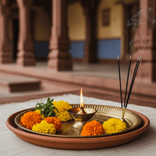
Aarti is an offering of light made to a deity, an honoured guest, or a sacred object. It is one of the most recognisable moments in Hindu worship: a priest or devotee circles a lamp—traditionally a flame fed by oil or ghee—before the deity, while bells ring and people gather close. The light itself is the offering. It is simple, beautiful, and done in thousands of temples and homes every single day.
The word aarti comes from Sanskrit and means "to remove" or "to ward off". In practice, it has come to mean the ritual itself. You will also hear it called arati.



Why aarti is performed
Aarti is an act of worship and gratitude. When you offer light to the divine, you are saying: I see you, I acknowledge you, I am grateful. The flame—pure, bright and alive—stands for consciousness, knowledge and the dispelling of darkness and ignorance. By circling it before the deity, the worshipper invites that light into their life.
There is also a practical beauty to the custom. The warmth and glow of a lamp creates an atmosphere of reverence. In temples, it gathers people together at particular moments of the day. It marks time and punctuates worship. Many temples perform aarti at dawn and dusk, at the opening and closing of the day.
Aarti is believed to carry prayers and intentions toward the divine. When you stand in the presence of aarti and feel its warmth, you are participating in an ancient exchange between the human and the sacred. You are not passive. You are offering and receiving at once.
The aarti thali and what it holds
The lamp used in aarti is held in a plate or shallow dish called an aarti thali. This is usually made of brass, silver or copper, and can be plain or elaborately decorated. The thali is often round and sits on a handle or stand, making it easy to rotate and move in smooth circles before the deity.
On the thali, alongside the lamp, there may be flowers—marigolds, roses or chrysanthemums depending on the season and tradition. There may be incense sticks, or a small dish of holy ash or vermilion. Some traditions include a bell on the thali itself, though often the bell is held separately and rung by another person.
The specific contents vary. In a simple household aarti, the thali might hold just the lamp. In an elaborate temple ceremony, it becomes an ornate focal point, heavy with symbolism and adorned with the finest materials the temple maintains.
How aarti is performed
The aarti thali is usually held by a priest or senior member of the household. The lamp—most commonly a small oil lamp or diya—burns brightly. The person circles the thali smoothly in front of the deity, moving it in clockwise spirals. The motion is deliberate and flowing, not rushed.
As the aarti is performed, a bell rings—sometimes continuously, sometimes in rhythm with the motion. People gather, often with their palms together in prayer. When the aarti is complete, the priest moves the thali toward the assembled people so that they can bring their palms close to the warm light, then touch their hands to their eyes and forehead. This is called receiving the aarti, or taking the aarti. It is an exchange: the blessing moves from the deity, through the flame, to the people.
In some traditions, small oil lamps are distributed, and people hold them aloft. In others, a single lamp circles and the community witnesses. The variation depends on the temple, the sampradaya (spiritual tradition) and the occasion.
Evening aarti and daily temple practice
Many temples perform aarti in the early morning and again in the evening. The evening aarti often draws larger crowds and carries a particular significance: it marks the transition from day to night, from activity to rest. As the sun sets, the lamp becomes more vivid against the darkening sky or the temple interior.
Evening aarti is sometimes called the main aarti of the day. For working people, it is often the moment when they can visit the temple. The ringing of bells and the gathering of voices create a shared experience of devotion. You will find evening aarti happening in temples across the country, from small neighbourhood shrines to large temples, at roughly similar hours each day.
Some homes also perform aarti in the evening as part of their family worship, even if they do not visit a temple. A small lamp is lit before a home shrine, prayers are offered, and the day is brought to a close with light and gratitude.
Aarti in daily life
You may encounter aarti in contexts beyond temple worship. When a revered teacher or elder visits, they may be welcomed with aarti. It is an expression of respect and the sacred worth of a person. At auspicious occasions—a wedding, a housewarming, the opening of a new business—aarti is performed as a blessing and a calling down of grace.
Some people perform a small personal aarti each morning as part of their sadhana, or spiritual practice. A lamp is lit, a mantra is spoken, and the day begins with awareness of the divine light within and around them.
Aarti asks very little: a lamp, a moment, and an open heart. Yet it has endured for centuries as a way of speaking to the sacred without words. If you ever find yourself in a temple during aarti, you need not know the prayers or the traditions in detail. Stand quietly, feel the warmth of the light, hear the bells, and simply be present. The practice does not require expertise. It requires only respect and sincerity.

Related Articles


