
What is Holi and why are colours played
Joy blooms where boundaries dissolve
Dharmayana
01 Oct 2026 • 6min
What Holi celebrates
Holi is the festival of colours and spring, observed by Hindu communities across India and around the world. It marks a turning point in the year: the end of winter, the arrival of the new harvest, and a renewal of relationships and community bonds. The festival falls on the full moon day in the month of Phalguna, in the lunar calendar, which usually aligns with March in the Gregorian calendar.
The name Holi comes from Holika, the demoness at the heart of the festival's oldest story. That mythology shapes not just the legend behind the festival, but the ritual and the colours themselves. Understanding Holi means understanding both the spring celebration it is and the divine story it remembers.



The story of Holika and Prahlad
The most widely told origin story of Holi involves the demon king Hiranyakashyap, his son Prahlad, and the demoness Holika. Hiranyakashyap was a powerful and tyrannical ruler who had grown arrogant with his power. He demanded that everyone worship him alone, but his own son Prahlad remained devoted to Vishnu, the god of preservation.
Enraged by his son's defiance, Hiranyakashyap plotted to kill him. He enlisted his sister Holika, who had a boon that made her immune to fire, to carry Prahlad into a blazing fire. But Prahlad's faith and devotion protected him. He emerged from the flames unharmed, while Holika perished. The story ends with Hiranyakashyap himself eventually destroyed by Vishnu's avatar Narasimha, the half-man, half-lion.
This myth carries a clear message: righteousness triumphs over evil, and genuine devotion protects even the powerless against tyranny. It is why Holika Dahan—the ritual burning of the demoness—is performed as part of Holi, celebrating the victory of good and the destruction of ego and harm.
Holika Dahan: the bonfire ritual
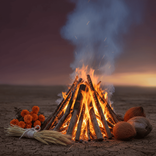
The night before the full moon, communities gather to perform Holika Dahan. A bonfire is lit, and people bring offerings of wood, dried dung, grains, and other dry materials to feed the flames. The bonfire itself is an act of purification: as the demoness burned, so do harmful energies, grudges, and the old year's accumulated negativity.
Families walk around the fire, sometimes circling it multiple times. Some offer new grains from the winter harvest to the flames as thanks and supplication. The warmth of the fire, the smoke, the shared gathering—these create a ritual space where people come together across caste and class, at least in many communities and regions. The bonfire's ashes are sometimes collected and applied to the forehead or body as a blessing.
The Holika Dahan fire is not abstract. It is a moment when a community physically gathers, watches the old burn away, and prepares itself for renewal. This is why the ritual is performed separately from the colour play that follows; each has its own meaning and moment.
The colours: why Holi is the festival of colours
The next morning, as spring light breaks, people emerge with coloured powders and water to play. They throw gulal—powdered colours—at one another, chase friends and strangers through streets and houses, and drench each other in coloured water. Children and adults alike return home stained and laughing. It is one of the few occasions in the Hindu calendar where social hierarchies soften; a child might playfully colour a grandparent's face, or a servant splash their employer.
The colours themselves are not arbitrary decoration. They represent the vibrancy of spring, the flowers that bloom after winter, the joy that follows hardship, and the diversity of creation. In the Bhagavata Purana, Krishna—the divine child and beloved god—is described as playing with colours with his friends. This connection between Krishna, play, and colours has become central to Holi's identity, especially in North India where Krishna worship is widespread.
The colours also carry a symbolic cleansing. Just as Holika Dahan burns away harm, the colours wash over the old year and old grudges. If you have wronged someone or quarrelled during the year, Holi is the occasion to seek forgiveness, to begin afresh. The colours are a visible sign that everyone has been treated the same, that boundaries have dissolved temporarily, and that relationships are being renewed.
Regional variations of Holi
Holi is observed across the Hindu world, but the way it is celebrated varies by region, language, and local practice. In Maharashtra, Holika Dahan is called Holi, and the colour play is secondary. In Bengal, the festival is known as Basanta Utsav or spring festival, emphasised more for its cultural and social renewal than for the Krishna mythology.
In some regions, coconut and sugarcane are offered in the Holika fire. In others, a ritual called Lathmar Holi sees women playfully strike men with sticks while men shield themselves with shields—a tradition particular to certain communities in North India. Some regions exchange sweets called gujhiya, others prepare different seasonal foods.
What remains constant is the core: a bonfire ritual that celebrates good over evil and purifies the community, followed by a joyful renewal of bonds through play and colour. The specific expressions shift with the place and the people, but the underlying principle—that spring is a time to shed the old and celebrate the new together—carries across.
Preparing for and observing Holi
If you are participating in Holi for the first time, or observing it with new intention, begin with awareness. In the days before Holika Dahan, many communities prepare by cleaning their homes and buying or making coloured powders. Some people fast or reduce certain foods as a spiritual preparation.
On Holika Dahan night, if you are able to, attend a community bonfire. Bring offerings if invited—typically wood or dried materials, or new grains. If you cannot attend a large gathering, even a small household fire or a moment of reflection on what you wish to release can honour the ritual's meaning.
On the morning of Holi, play with colours joyfully, but also with awareness. Use natural, plant-based colours where you can; synthetic colours can irritate skin and eyes, and staying rooted in the natural world is part of the festival's spirit. Forgive someone you have quarrelled with. Eat together, exchange sweets, and allow the day to be what it has always been: a moment when rigid boundaries soften and community is renewed.
Common questions
When is Holi celebrated?
Holi is observed on the full moon day (Purnima) of the lunar month Phalguna, which typically falls in March. The exact date shifts each year because it follows the lunar calendar. Holika Dahan is celebrated the night before, and the colour play happens the following morning.
Can I play Holi if I'm not Hindu?
Yes. Many communities celebrate Holi across religious lines, and the festival's spirit of renewal and joy is open. If you're invited to join, ask your hosts what is expected and welcome—in most places, the colour play is joyful and inclusive. Always ask before applying colour to someone's face.
What if I have sensitive skin or allergies?
Use plant-based or natural colours rather than synthetic powders, which can irritate skin and eyes. You can also participate by staying present with the community without playing with colours, or by setting boundaries beforehand with those around you. The spirit of Holi is connection, not obligation.

Related Articles


