
What is Purnima and why it matters
The full moon marks the rhythm of your year
Dharmayana
01 Oct 2026 • 5min
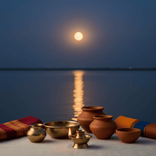
Purnima is the full moon day in the Hindu lunar calendar - the day when the moon is completely lit by the sun as seen from Earth. It occurs roughly every 29.5 days, marking the completion of a lunar month. For thousands of years, Purnima has been far more than an astronomical event. It anchors your year to natural rhythms, structures your ritual life and is believed to amplify both spiritual practice and the workings of the mind.



How Purnima shapes your year
The lunar calendar divides each year into twelve months, each bounded by a Purnima. We name these months for the Purnima they contain: Chaitra Purnima, Vaishakh Purnima, Jyeshtha Purnima, and so on through the year. This means Purnima functions as both marker and boundary - the completion of one month and the threshold to the next.
This structure is built into the panchang, the traditional calendar that gives Hindus their dates for festivals, vratas (fasts) and rituals. When you read that a festival falls on Vaishakh Purnima, you know exactly when that is relative to the earth's position in its orbit around the sun. No confusion, no slipping dates: Purnima locks your spiritual calendar to the cosmos.
Why the full moon is considered auspicious
Hindu practice holds that Purnima is an auspicious day - a day when your inner state and outer circumstances are more aligned, when spiritual effort bears greater fruit. The reasons sit in observation and belief together.
Astronomically, the full moon brings the brightest light to Earth at night. Practically, this meant pre-industrial people could work, travel and gather after dark on Purnima nights. Spiritually, that brightness is believed to correspond to clarity of mind and heightened energy. Many people report deeper sleep and vivid dreams near Purnima; others find meditation clearer or their thoughts more settled. Whether you experience this as physiology or as attunement to lunar influence, the perceived effects are real to those who practice.
Because Purnima is thought to amplify whatever you direct your energy toward, it becomes a powerful day for ritual and for setting intention. A mantra or intention held on Purnima is believed to carry greater weight. This is why many people choose Purnima to begin a new practice, to make an offering, or to renew their commitment to dharma.
Purnima vrats and fasting
Many Hindu practitioners observe a vrat on Purnima - a fast that ranges from complete abstinence from food and water, to eating only fruit or dairy, to observing fasting from sunrise to moonrise. The vrat is not punishment or deprivation: it is training. It sharpens your mind and will, links you to a wider community of practice, and is an offering - you redirect the time and resources you would spend on food toward prayer or service.
Different sampradayas and regions have their own Purnima vrat traditions. Some households fast once a month on each Purnima. Others fast only on the Purnima of particular months - Kartik Purnima in autumn, for instance, is widely observed with fasting and bathing in sacred waters. Still others fast on Purnima only as part of preparing for a particular ritual or requesting something specific.
What matters is not the severity of the fast but your intention and consistency. Even a modest fast - eating once, or drinking milk only - becomes meaningful if you hold it with awareness.
Spiritual practice on Purnima
The brightness and energy of Purnima make it a day when many practitioners intensify their practice. You might do more japa (repetition of mantra), extend your meditation, or visit a temple. Some people perform specific rituals or pujas on Purnima. Others simply sit outdoors under the full moon and chant or pray.
The Bhagavad Gita mentions that Arjuna began his studies with Krishna on a full moon. Many texts suggest that knowledge received on Purnima is more easily retained. If you are learning something significant - a new mantra, a ritual, a teaching from a guru - Purnima is considered an auspicious time to begin.
You do not need any special preparation to observe Purnima spiritually. Bathing, dressing cleanly and sitting in a quiet space are enough. Some people light a lamp or prepare an offering of flowers, water or fruit. The essential thing is your attention and intention, not the externals.
Purnima in daily life
For those following the lunar calendar closely, Purnima and the corresponding Amavasya (new moon) two weeks later divide the month into two halves, each with its own rhythm and character. The Purnima half is thought to support outward activity, socialising and beginning new projects. The Amavasya half is more inward, better for completion, rest and introspection. Many practitioners align their schedules to this natural pulse.
Even if you do not follow such a structured practice, noticing Purnima can anchor you differently. You might simply observe the full moon once a month, whether by looking at it, spending time in quietness, or remembering for a moment that you are part of a vast cycle - one that humans have tracked and honoured for millennia.
Common questions
Can I observe Purnima if I am away from a temple?
Yes. Purnima is observed at home and in nature as commonly as in temples. Bathing cleanly, sitting quietly, lighting a lamp or spending time under the moonlight are all sufficient. Your intention matters more than location.
What should I eat if I am fasting on Purnima?
This depends on the type of fast you are keeping. Some people eat no food and drink only water; others eat fruit, dairy and nuts only; others eat once at noon. Choose what suits your health and what feels right for your practice - consistency matters more than severity.
Does Purnima fall on the same date each month?
No. Because Purnima follows the lunar cycle, it occurs roughly every 29.5 days, so the date shifts each month. The panchang tells you the exact date for each month's Purnima based on the lunar calendar.

Related Articles


