
What is rangoli and why is it drawn at the door
Beauty as blessing at the threshold
Dharmayana
29 Sep 2026 • 5min
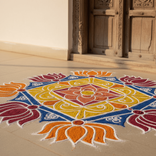
Rangoli is a coloured design drawn on the ground, usually at the entrance of a home or a sacred space. It is made with coloured powders, rice flour, flowers, or other materials, and it marks a threshold as a place of welcome and auspiciousness. The word rangoli comes from the Sanskrit rang, which means colour.
In some parts of India, especially in the south, the same practice is called kolam. Whether it is called rangoli or kolam, the purpose is the same: to invite good into the home and to honour the space with beauty and intention.



Why rangoli is drawn at the door
A rangoli at the doorway marks a boundary between the outer world and the inner home. It is a visual invitation to good fortune and to the divine presence. The design says: this threshold is sacred, this space is cared for, this home is open to blessing.
There is also a practical reason. Traditionally, the powders used in rangoli come from grain and spices that are ground fine. Some people say that these materials have protective qualities, or that they invite auspicious energies into the home. Whether or not you believe in those powers, the act of creating a rangoli is itself an act of intention and care, and that matters.
What rangoli designs mean
The designs vary by region, season and occasion. A simple geometric pattern - a square, a diamond, a lotus - can be a rangoli. So can an elaborate scene with flowers, birds, leaves, or sacred symbols. Many rangoli feature the lotus, a flower that holds deep meaning in Hindu and Buddhist traditions as a symbol of purity and spiritual growth.
Other common designs include stars, waves, spirals, and the lotus feet of a deity. During festivals like Diwali, rangoli often features patterns linked to light and celebration. During other times, a rangoli might simply be a daily practice, something drawn each morning as an act of devotion or care.
The design is not meant to last. After a day or two, the rangoli fades or is swept away. This is part of the point. Rangoli teaches that beautiful things are temporary, that the act of creating them matters more than their permanence, and that we can make something sacred even if it does not endure.
Rangoli across India
Rangoli is not practised the same way everywhere. In Maharashtra and Karnataka, elaborate, colourful rangoli with intricate patterns are common, especially during festivals. In Tamil Nadu and Andhra Pradesh, kolam is often geometric and uses rice flour, sometimes with a hole in the centre where a lamp can be placed. In Gujarat, the designs tend toward bold, bright colours and bold geometric forms. In Bengal, a similar practice is called alpana.
Each region has its own style and its own materials. But the core idea is the same: to mark a threshold, to create beauty, and to set an intention for the home.
How rangoli is made
A rangoli can take anywhere from ten minutes to several hours, depending on its size and complexity. Some people sketch a design lightly on the ground first, others work freehand. The most common materials are coloured powder - bought in packets or made from rice flour mixed with natural dyes - and rice flour paste. Flowers, grains, and coloured sand are also used.
The process is meditative. You work close to the ground, moving your fingers or a stick or a special applicator to lay down colours in lines and shapes. Many women learn to make rangoli from their mothers or grandmothers, and the practice carries memory and tradition forward.
Nowadays, you will also see rangoli made from modern materials - acrylic paints, adhesive vinyl, printed designs. These versions last longer and require less skill to execute. But the spirit is the same: to create something beautiful at the threshold, to welcome the day or the festival, to set the tone for what happens inside.
Rangoli as devotion and daily practice
For many households, drawing rangoli is an act of daily care. It is done in the morning, before the day begins. It is often combined with other threshold rituals: lighting a lamp, placing flowers, offering water. Some people draw rangoli as part of puja, a ritual of worship or gratitude. During festivals, rangoli becomes more elaborate and more public - a way of celebrating with the community and expressing joy.
Rangoli is also a form of folk art. It is practised by people across religions and regions, and it has been recognised by UNESCO as an important element of intangible cultural heritage in India. It requires no special training and no special talent, just intention and practice. Anyone can make a rangoli.
The act of drawing rangoli connects you to a practice that has existed for centuries. It also connects you to the present moment. As you work, your mind settles. You are focused on colour and pattern and shape. You are creating something for its own sake, not for profit or recognition, simply because it is beautiful and because it marks something as important.
If you want to begin making rangoli, start small. A simple pattern of circles, or a lotus outline, or a geometric form. Use rice flour mixed with water, or coloured powder from a shop. Work at your doorway or in a corner of your home. Notice how it feels to create something that belongs to a tradition older than you are, and that will fade away, and that matters anyway.

Related Articles


