
What is sankalpa and why it matters in puja
Intent spoken aloud, resolve made sacred

Dharmayana
01 Oct 2026 • 6min
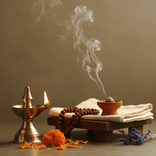
A sankalpa is a formal statement of intention spoken at the beginning of a puja or other ritual practice. The word means "intention" or "resolve" in Sanskrit. When you take a sankalpa, you declare to yourself and to the divine why you are performing the ritual—what you are seeking, what you wish to accomplish, or what you are grateful for. It is not a casual wish but a stated commitment, made consciously and with full attention.
The sankalpa transforms a ritual from mere mechanical action into something personally meaningful. Without it, puja can feel like going through motions. With a sankalpa, the ritual becomes an offering rooted in your own authentic purpose.



Why sankalpa comes first
A sankalpa is typically spoken at the very beginning of puja, after you have bathed, settled into a clean space, and lit the lamp. It comes before you invoke the deity, make offerings, or recite mantras. This positioning is deliberate. By stating your intention first, you set the direction for the entire ritual that follows. Everything that comes after—the flowers you offer, the words you speak, the time you spend—flows from that intention.
Think of it like drawing a map before you set out on a journey. The sankalpa is your map. It tells you where you are going and why. This clarity of purpose is said to make a ritual more effective. When your mind, your words and your actions all move in the same direction, they have power.
What a sankalpa contains
A sankalpa usually includes several elements. You typically begin by naming yourself, your lineage or parentage, and the place or circumstances in which you are performing the ritual. Then you state what you are doing: "I am performing puja to Devi" or "I am fasting on Ekadashi". Finally, you express the purpose or fruit of that action: "for the health of my family", "for the removal of obstacles", "in gratitude for blessings received", or simply "with devotion".
The exact form varies. Some traditions use a fixed sankalpa spoken in Sanskrit, often inherited from a guru or a family lineage. Others allow the sankalpa to be spoken in your own words, in your own language, from your own heart. What matters is that it is sincere and specific to you. A vague wish—"for good things to happen"—lacks the weight of real intention. A sankalpa has substance.
Sankalpa in different ritual contexts
Sankalpa is most commonly associated with daily home puja, where it helps the practitioner stay focused and connected to purpose. But it is used more broadly. A sankalpa is taken before an important fast, before attending a temple ritual, and before beginning a course of spiritual practice like meditation or yoga. In each case, it serves the same function: to mark the moment when you step from ordinary time into sacred time, and to affirm your commitment.
In some traditions, particularly in temple worship and in certain Vedic rituals, the sankalpa follows a more formal structure and may be recited in Sanskrit by a priest. The content is similar—naming the person, the date according to the panchanga (Hindu calendar), the deity and the purpose—but the language is more ritualized. Whether formal or informal, the sankalpa remains a bridge between your inner intention and the outer act of worship.
How sankalpa shapes your practice
Taking a sankalpa is a psychological and spiritual act. Psychologically, it focuses your attention. It prevents your mind from wandering during the ritual and keeps you engaged with what you are doing. Spiritually, it is an acknowledgement that your practice is not random or obligatory but chosen and meaningful. You are saying: this matters to me, and I am here for this reason.
Over time, the sankalpa can deepen your practice. If you return to the same puja or the same ritual regularly, and you state your intention each time, you build a conversation between yourself and the divine. Your intention may evolve. You may begin by seeking something specific, but as your practice develops, your intention might shift toward gratitude, or surrender, or simply the joy of connection. The sankalpa allows this evolution to be visible and conscious.
A sankalpa also brings integrity to ritual. It prevents puja from becoming rote performance. If you must speak your intention aloud, you cannot lie to yourself about why you are there. You cannot hide vague hopes or confused motives behind empty ritual. The sankalpa asks you to know yourself and to speak truthfully.
Taking a sankalpa: practical steps
To take a sankalpa, sit facing the altar or lamp in a clean, quiet place. Close your eyes for a moment and let your attention settle. Then speak, either aloud or in a low voice, a clear statement of your intention. It can be as simple as: "I am doing puja today with gratitude for my family's wellbeing" or as formal as a Sanskrit verse learned from your tradition. The important thing is that you speak it consciously, that you hear your own words, and that you mean them.
If you are new to this, you do not need to memorize Sanskrit or follow a complex formula. You can speak in your own words, in your own language. What matters is sincerity and specificity. Name what you are doing, name why you are doing it, and let yourself feel the truth of those words as you speak them. That is a sankalpa.
If you forget to take a sankalpa at the start, you can still take one at any point during your practice. It is not too late. The sankalpa is always available to you, whenever you remember that you want to practice with intention rather than on autopilot.
Taking a sankalpa
- Prepare your space Sit in a clean place facing your altar or lamp. Bathe beforehand if possible, and wear clean clothes.
- Settle your mind Close your eyes for a moment and let your attention come inward. Take a few slow breaths.
- Speak your intention Aloud or in a low voice, state clearly what you are doing and why. Name yourself, the ritual, and its purpose. Speak in Sanskrit if you know it, or in your own words and language.
- Feel the words As you speak, let yourself feel the truth and sincerity of your intention. Notice how it anchors you to the present moment.
Common questions
Can I take a sankalpa in English or do I need to use Sanskrit?
You can use either. Many traditions have formal Sanskrit sankalpas passed down through lineages, but a sincere intention spoken in your own language is equally valid. What matters is that you speak consciously and mean what you say.
What happens if I forget to take a sankalpa at the start?
You can take one at any point during your practice. It is not too late. The sankalpa is simply your conscious intention, and you can return to that awareness whenever you remember.
Is a sankalpa only for puja or can I use it for other practices?
A sankalpa is used before puja but also before fasting, meditation, yoga practice, and other spiritual rituals. It works anywhere you want to practice with clear intention rather than habit.

Related Articles


