
Why camphor is burnt during aarti
The flame that carries offering to the divine
Dharmayana
29 Sep 2026 • 5min
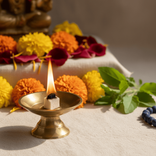
When you light camphor during aarti, you are performing an act of worship that is rooted in both spiritual meaning and practical logic. Camphor is burnt because it burns completely, leaving no ash—a symbol of total surrender to the divine. The flame itself becomes the offering, and the devotee's gesture of circling the flame before the deity carries the essence of that offering upward.
Camphor has been used in Hindu worship for centuries. The Sanskrit word for camphor is kapur, though you will also hear it called karpur. In ritual contexts, it appears as a solid block that is lit at the climax of aarti—the rotating of a light or flames before a deity as an act of reverence. This is not a casual detail of practice. The choice of camphor over other materials speaks to what the ritual is meant to accomplish.



Why camphor burns completely
One reason camphor is preferred for aarti is its nature as a substance. When you light a piece of camphor, it does not smoulder or leave behind ash and residue the way incense or wood does. Instead, it burns with a steady, bright flame and disappears almost entirely. This complete combustion is understood spiritually as a perfect offering—nothing wasted, nothing left behind. In a ritual context, this matters. If you are making an offering to the divine, the idea that your offering burns away without remainder can symbolise the completeness of your devotion.
The practical benefit is clear too. Because camphor produces a clean flame without smoke or soot, it does not mark the deity or the altar space with dark residue. This is especially important in home pujas where you are working with limited space and materials that must remain clean for repeated worship.
Camphor meaning in ritual
In the vocabulary of Hindu ritual, camphor represents purity and the dissolution of the ego. The Atma or soul, in many philosophical schools within Sanatan Dharma, is understood as eternal and unchanging—like camphor, which leaves nothing behind because it has no true substance to begin with. When you watch camphor burn, you are watching a teaching: form is temporary, but what animates that form persists.
This is why the moment of kapur aarti, as it is sometimes called, is considered especially auspicious. It is often performed at the end of a puja, as the culminating gesture. The devotee holds the flame before their own face, absorbing its heat and light, then circles it before the deity. This act is called arati or aarti. The heat and light of the camphor are said to carry the prayers and intentions of the worshipper toward the divine.
How camphor is used in aarti
Camphor used in aarti is usually sold as a solid block, a thumbnail-sized piece of white or translucent resin. You light it on a metal plate or in a small dish, and it catches flame immediately. The block will burn for a minute or two—long enough to complete the circling of the flame before the deity and to allow worshippers to bring their hands up through the flame and touch their face and head, a practice called taking the arati.
Some traditions use a camphor aarti lamp, a small brass or metal vessel with a wick soaked in ghee alongside a piece of camphor, creating a mixed flame. The effect is the same: the camphor burns, the light rises, and the offering is complete.
The materials you need are minimal—camphor, a small metal plate or aarti lamp, and a way to light it. In temples, the person performing aarti is usually trained in the practice and will handle the materials with care. In a home setting, you can perform kapur aarti yourself, though many people choose to do it as part of a guided puja or under the guidance of someone experienced in the practice.
Camphor in daily and festival worship
You will encounter camphor aarti most commonly during the aarti performed in temples each day—usually in the early morning, at midday, and in the evening. It is also a central part of major festivals. During Diwali, camphor aarti takes on additional significance as part of the broader use of light to honour the victory of knowledge over ignorance. During Navratri, camphor burns as part of the daily aarti performed before the goddess.
In home worship, many families maintain a small supply of camphor for use during personal pujas or on significant days. It is an inexpensive material, widely available, and requires no special preparation. This accessibility is part of why it has remained central to worship practice across India and among Indian diaspora communities for so long.
A practice that connects to something larger
Using camphor in aarti is part of a larger system of sensory engagement in worship. The ritual involves sound—bells and chanting—smell from incense and flowers, the tactile experience of taking the arati, the visual spectacle of the flame and the deity it illuminates. Camphor's role is to provide a pure, bright light that carries the offering in a form that burns away completely.
When you perform or receive aarti, you are participating in a practice that has carried meaning across generations. The camphor is not mere symbolism or decoration. It is a material choice with spiritual logic behind it—one that has been refined through centuries of worship to do precisely what it does: burn completely, produce a steady flame, and carry an offering toward the divine. The simplicity of it is part of its power.

Related Articles


