
Why coconut is broken during puja
Sacred fruit, broken witness

Dharmayana
01 Oct 2026 • 8min
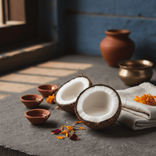
When you break a coconut during puja, you are performing one of the most recognisable rituals in Hindu worship. The coconut hits the ground or an altar stone, the white flesh scatters, and something feels complete about the moment. This is not theatre or accident: coconut breaking carries deep meaning woven through philosophy, symbolism and everyday practice.
The coconut represents the self. Its hard outer shell is the ego, the protective layer that keeps us separate and defended. Inside, the white flesh and the water within speak to our inner being—our consciousness, our capacity for growth. When you break the coconut, you break through the ego. You surrender what keeps you closed. You offer your whole self to the deity and to the sacred moment. This is why coconut breaking appears not just in private home worship but in temple ceremonies, in rituals at important life transitions, and whenever someone seeks blessing or protection.
The ritual has another layer. The coconut offers many things: the shell, the white flesh, the water, the kernel. None of it goes to waste. In offering the coconut, you are saying that you give everything you have, without reservation. The practice teaches generosity and the principle of total surrender—concepts central to bhakti, devotional practice.



The symbolism of offering
The coconut is native to the Indian subcontinent and appears throughout Hindu texts as a sacred fruit. It stands for completeness because it contains everything needed to sustain life: water for drink, flesh for food, fiber for use, and a hard protective shell. To break it means to acknowledge that nothing is truly yours to hold back. What you have—your health, your skills, your time, your resources—comes from the divine. Breaking the coconut is the gesture that says this aloud.
In many temples, coconut breaking happens at specific moments. When someone enters a shrine for a major puja, they may break a coconut. When a prayer for a difficult situation is about to begin, the coconut breaks first. When a child is brought to the temple for the first time, or when someone recovers from illness, or when a business is opened, the coconut goes down. These moments share something: they are thresholds. They are places where one state ends and another begins, where human effort meets divine grace, and where a person needs to step across consciously rather than drift.
How the practice connects to devotion
Coconut breaking is not violence or destruction. It is communication. When you perform the ritual with intention, you are speaking to the divine in a language older than words. The hard shell represents the barriers we all carry—doubt, fear, attachment, pride. The breaking of it is an act of honesty. You are telling the deity and yourself: I cannot break through these barriers alone. I need help. I surrender them now.
This is why the ritual often comes before prayer or petition. You break the coconut, then you ask. The order matters. You have already offered yourself; now your request comes from a place of humility rather than demand. Different traditions emphasize different aspects of this surrender. Some see it as breaking the ego's hardness; others see it as making an opening for divine grace to enter; still others focus simply on the principle of giving without condition.
Regional and ritual variations
The practice of breaking coconut appears across India, but not identically everywhere. In South Indian temples, coconut breaking is standard practice in many shrines, and devotees often purchase coconuts at temple gates for this purpose. In parts of North India, coconut is offered but not always broken in front of the deity; instead it may be broken in a preparation area and then offered as prasad—food blessed and returned to the worshipper. Some temples use a small hammer or mallet placed on the altar stone; others ask the devotee to strike the coconut by hand against a designated stone. A few traditions break a coconut only at specific times or for specific ceremonies, while others incorporate it into regular weekly or daily worship.
The gender of the person performing the ritual has no bearing on its validity. Anyone who approaches the deity with sincere intention can break a coconut. Some families have one member do it for everyone present; others believe each person should offer their own. Neither practice is more correct than the other. What matters is the intention behind the action.
What happens to the coconut after
In most temples and homes, the broken coconut becomes prasad. The white flesh is distributed among those present, sometimes kept for the temple or family, sometimes cooked into an offering to be shared. Nothing is wasted. The water inside the coconut is sometimes collected and given as prasad, particularly in South Indian practice. This second part of the ritual—receiving the coconut back as blessed food—completes the circle. You have given everything; now you receive a portion of it back, transformed by having been offered. This exchange is the heart of puja itself.
Some traditions say that eating the prasad from a coconut you have broken deepens the ritual's effect. It is not merely symbolic; the practice teaches that what we offer returns to us, nourished and blessed. This is not about transaction—giving in order to receive. It is about learning that separation between giver and receiver, self and divine, is an illusion. When you break the coconut and then eat it, you participate in understanding that truth.
When to break a coconut
There is no single rule for when coconut breaking is appropriate. It is part of formal temple puja, but it also appears in household worship on important days. Some people break a coconut every morning as part of their daily practice; others reserve it for festivals, weddings, the opening of something new, or times of difficulty. If you are visiting a temple and unsure whether to break a coconut, look around. Most temples have a designated place for it, and staff or other worshippers can guide you. Many temples sell coconuts at the entrance for this purpose, or you can bring your own.
If you are practicing at home, a coconut can be part of your altar setup or ritual, or it can stand alone as a complete practice in itself. The size of the coconut does not matter. Neither does the time of day. What matters is that you approach it with awareness of what you are doing—not mechanically, but as an act of speaking to something larger than yourself.
The coconut has been part of Indian spiritual life for centuries. It asks nothing complicated of you. It asks only that you break through what keeps you separate, offer what you have, receive what returns, and trust the exchange.
Breaking a coconut in puja
- Choose or purchase your coconut Select a fresh coconut that feels heavy for its size, which indicates it contains water. At temples, coconuts are usually available for purchase near the entrance or at vendor stalls outside.
- Locate the breaking stone or designated place Find the altar stone or designated breaking area, usually a flat stone surface set at the base of the shrine or a particular spot in the temple. Most temples have this marked; at home, use a sturdy flat stone or designated altar area.
- Hold the coconut firmly Grip the coconut with both hands so that one of its seams—the natural line running along the shell—faces downward toward the stone. Keep your fingers away from where it will strike.
- Strike down with intent Bring the coconut down sharply against the stone, aiming for the seam. Strike with controlled force rather than tentative taps. Most coconuts break cleanly with one or two strikes if aimed correctly at the seam.
- Offer the broken coconut Once broken, immediately present both pieces toward the shrine or deity as an offering. Pause briefly to acknowledge the gesture. Many people bow or place a hand to their heart at this moment.
- Collect and distribute as prasad The temple staff or you yourself will collect the coconut pieces. The white flesh becomes prasad and is distributed to those present, either raw or after being prepared into an offering. Receive it with your right hand or both hands as a blessed gift.
Common questions
Can anyone break a coconut during puja or is it only for certain people?
Anyone can break a coconut during puja regardless of gender, age or background. The intention matters, not who performs the ritual. In some families one member does it for everyone present; in others each person offers their own. Both approaches are valid.
What do I do if the coconut doesn't break cleanly?
If the coconut does not break on the first strike, you can strike it again. Some people see difficulty in breaking as part of the practice—it teaches persistence and humility. There is no penalty or negative consequence if it takes multiple attempts.
Is coconut breaking required as part of puja or is it optional?
Coconut breaking is not mandatory for puja to be valid. Many rituals proceed without it. However, it is considered auspicious and is a common part of temple worship and household puja, especially for important occasions or when seeking blessing for something new.

Related Articles


